How We Built Our 2026 Fair Market Value Estimate Guide for Donated Items

Charity Record
charityrecord.com/When you donate a bag of clothes or a box of kitchen gear, the hardest part of the process can be answering "What was it worth?" Charity Record's fair market value estimate guide helps you ground your answer during tax season, and you can find it easily in our donation tracking software, built into our item donation form.
On May 9, we released guide version 2026.1, our first independently built FMV estimate guide. This post explains how we built it, why we built it, and what it can and cannot do for you.
Why listen to us?
We're Charity Record, a donation tracking tool for U.S. taxpayers built after Intuit shut down ItsDeductible in 2025. We track seven donation types (items, cash, mileage, stock, vehicles, digital assets, and art) and export to CSV, PDF, HTML, and TXF for tax software. See how Charity Record compares as an ItsDeductible alternative.
Why we built our own FMV estimate guide
Our 2025 FMV estimate guide was built from the fair market value data Intuit published while winding down ItsDeductible. As a bridge for Charity Record's first tax year it served us well. But 2026 is a new year, and we knew the only way to ensure we had a reasonable FMV estimate guide moving forward was to build our own.
For 2026's guide, we started over from raw market evidence. Guide version 2026.1 shipped with the following stats:
- 1,846 items with suggested values (up from 1,757 in the legacy ItsDeductible guide)
- Up to three value tiers per item: 1,365 items have three, 280 have two, and 201 support a single suggested value
- 983 search aliases, which are a new concept in this year's guide. When you search "Boppy", you'll find Nursing Pillow, and "Dust Ruffle" will fetch Bed Skirt
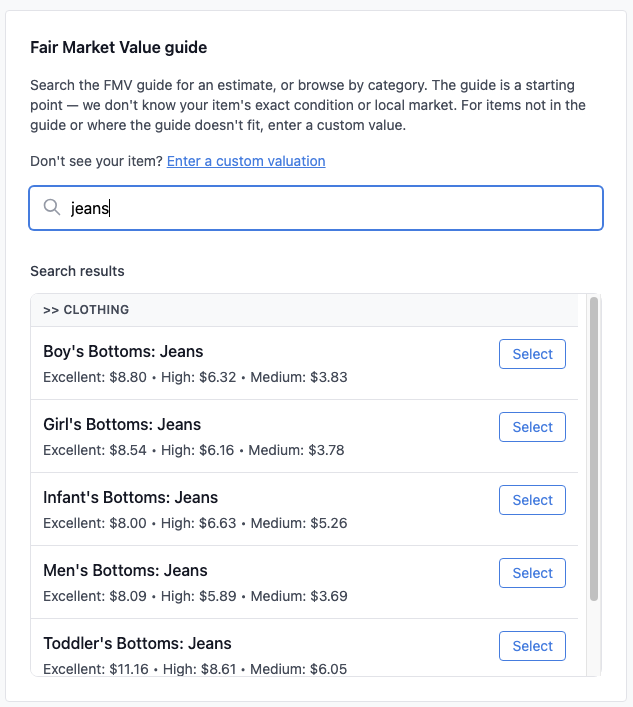 The 2026 guide at work: a "jeans" search with age groups and value tiers.
Where the numbers come from
We started with a registry of 340 candidate sources of used-item pricing. This was a diverse set... think charity valuation guides, consignment sale listings, resale marketplace data, and similar published material.
After screening for quality (and provenance – you'd be surprised how many potential sources were thin republished versions of others' guides!), we were left with 187 eligible price-bearing sources across 117 publisher families. Of those, 183 sources across 113 publisher families contributed 16,877 price observations to the released guide. The observations date from 2007 all the way through 2026 – more on that in a moment.
We had to do a little further filtering from there. For example, twenty otherwise useful sources had terms restrictions we treated as preventing reuse, so we excluded them. Some of their items found support elsewhere, but that screening led at least 313 otherwise-uncovered item candidates to stay out of the guide.
And as for the old 2025 ItsDeductible guide? It served purely as a benchmark in this process – our guide traces back to our own source registry and has its own lineage, completely separate. But it also helped us make the coverage comparisons in this blog post!
How fair market value is determined for each item
Want to see some of the details behind the guide? We thought so!
We had a seven-step pipeline to build the values:
- Normalization. "Mens dress shirt", "Men's Dress Shirts", and "dress shirt (men)" can all describe the same item. We standardized spelling, singulars and plurals, possessives, and ambiguous names before combining matching observations under one item.
- Categorization. Shopify's MIT-licensed Standard Product Taxonomy provided the starting structure for our published categories, which we adapted into a 21-category Charity Record taxonomy. We used a source's own categories only as context when an item name or label was ambiguous.
- Inflation adjustment. Older observations were restated in January 2026 dollars using the most specific applicable Bureau of Labor Statistics Consumer Price Index series.
- (Sometimes) Depreciation guardrails. Published federal household-property depreciation references mostly acted as caps or limits. In four categories (Musical Instruments, Vehicles & Parts, Pets, and Health) the rates also helped set the spread between tiers. To be clear, these aren't IRS charitable-valuation schedules... they're guardrails we used in our estimate methodology. The Allowance List–Depreciation Guide (ALDG) framework has been applied in federal claims decisions involving household goods, but as far as we could find while compiling the 2026 guide, not by the IRS for charitable donations.
- Outlier trimming (Recency and Winsorization). Where we had sufficient data, we capped values at each item's 5th and 95th percentiles before averaging. For items with more than ten observations, we chose the ten most recent, rotating among publisher families so one family couldn't dominate the result.
- Handling thin evidence. In some cases, only a single source (or family of sources) supported an item. Where the evidence couldn't support a third tier – or any range at all – we included two guide tiers or a single value instead.
- Human review. At several points, we stopped and reviewed the output by hand. This was to do "everything else" you hit with a data pipeline – merging ambiguous item names, excluding unsupported items, correcting category placement, limiting tiers, flagging prices that didn't pass a common-sense check, and the like. We logged 218 manual editorial decisions during this step.
At the end of that process, every published item can be traced back to its market observations and – where applicable – the editorial decisions behind it.
Checking our work
After all of that work, we asked ourselves: this looks great, but is it a useful guide?
As a sanity check, we ran benchmarking exercises before we released it: we replayed past item entries from real (aggregated and anonymized) donation records already in Charity Record, compared coverage against a valuation table published in a licensed tax-professional reference, and again compared coverage with the 2025 ItsDeductible guide.
Our finding? Our guide was looking really good!
In an anonymized replay of prior guide usage, our 2026.1 release would have matched 89.7% of prior guide-linked entry lines – and 94.4% when weighted by the number of donated items. And against the tax-professional reference table? The guide covered 81 of 84 items, or 96.4%.
Now, the caveat: those were coverage checks only. The reference prices in those other sources were never used as inputs; our pricing inputs were limited to the sources described in the Where the numbers come from section above. For the replay, we were counting whether a prior selection had a corresponding row in the final guide.
But suffice it to say, our 2026 guide benchmarks extremely well against the legacy ItsDeductible guide. It carries more priced items (1,846 versus 1,757), can offer a third value tier where the evidence supports one, and adds 983 genuinely useful search aliases.
What donors have done with it since May
As we mentioned above, the guide has been live in Charity Record since May. Since then, active users have leaned on it to help estimate the value of their donations.
Want to see how it's going? We thought you would!
The numbers below come from our production data – aggregated and anonymous per our terms of service – covering May 9 through July 30. They exclude real users' imported data, any staff testing, and inactivated accounts:
- Donors manually entered more than 10,000 item lines, representing more than 36,000 donated items.
- Among manually entered item lines on donations dated in 2026, 85.5% were valued with help from the guide. Weighted by the number of donated items, that share was 87.9%.
- 98.6% of donors who manually recorded a 2026 item donation used the guide at least once.
- Nearly all guide-assisted item lines used one of the suggested tier values.
That's strong evidence. Of course, these are product-use statistics, not proof that every estimate was right for every donated item. When you use the guide, you can accept an estimate when it looks reasonable for your item, the item's condition, and local market conditions, or override it when you know your item better. Which brings us to the most important part...
The guide's limits
It's important to understand that, whether you agree with the new guide's methodology or not, the Charity Record FMV estimate guide is a starting point, not an appraisal. And Excellent, High, and Medium are Charity Record value tiers, not IRS-defined condition grades.
For all of the work that went into the data pipeline and released guide, we are still missing information. We don't know your item's exact condition, we aren't privy to your local market conditions, and we can't determine whether your item qualifies for a deduction. The IRS describes valuation approaches in Publication 561, but it doesn't prescribe a formula – for example, for clothing, it even says valuation "does not lend itself to fixed formulas or methods." It also says the prices buyers actually pay in thrift or consignment stores are an indicator of value.
The takeaway is this: you are ultimately responsible for the values you claim on your tax return. We built Charity Record to have a strong FMV estimate guide, but it's also designed to be easy to override with your own values and notes. You need to keep any donation acknowledgment and other records the IRS requires, along with support for the item's condition and value. Dated photos and comparable sales may provide additional support. Our receipt requirements guide covers recordkeeping rules.
For a fuller picture, see How the FMV guide works in our help center, and IRS Publication 561 for official valuation guidance. For a broader walkthrough of estimating what your donations are worth, see our donation value calculator post.
What's next
Hopefully, your next step is to try it! The guide is live in the item donation form: add an item donation, then search or browse the 2026 guide right from inside the form. And you can start without obligation beyond adding and verifying an email address – Charity Record is free up to $500 in donations tracked, and signing up takes about a minute.
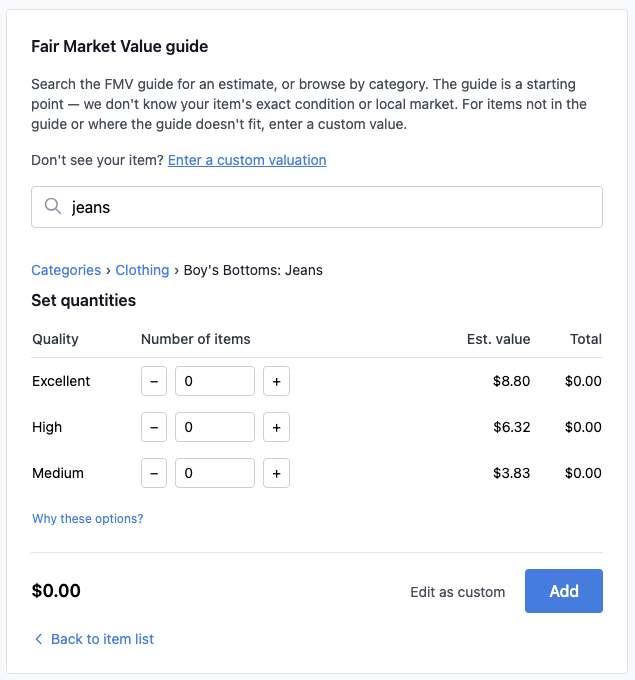 Pick value tiers and set quantities.
And if we release a new guide? Our FMV estimate guides are versioned internally, so corrections and additions will ship as independent releases. Our promise to you is we'll never rewrite your past values when a new guide ships. And if you donate something the guide misses, you can suggest it right from the item form. Suggestions are anonymous, feed the review queue for the next release, and are handled under our Privacy Policy and Terms of Service.
However you use the guide, we'd like to hear how it goes. Tell us what's working – and what's missing – through our contact page, and enjoy Charity Record!
Charity Record is a donation tracking tool, not a tax advisor. Guide values are estimates based on publicly available data and our detailed methodology, not professional appraisals. You are ultimately responsible for the valuations you claim and for keeping supporting records. Consult a tax professional for advice specific to your situation.
About Charity Record
The Charity Record Team
Ready to track your donations?
Create a free account and start organizing your charitable giving for tax time.
Create Free AccountFree up to $500 in donations tracked. No credit card required.